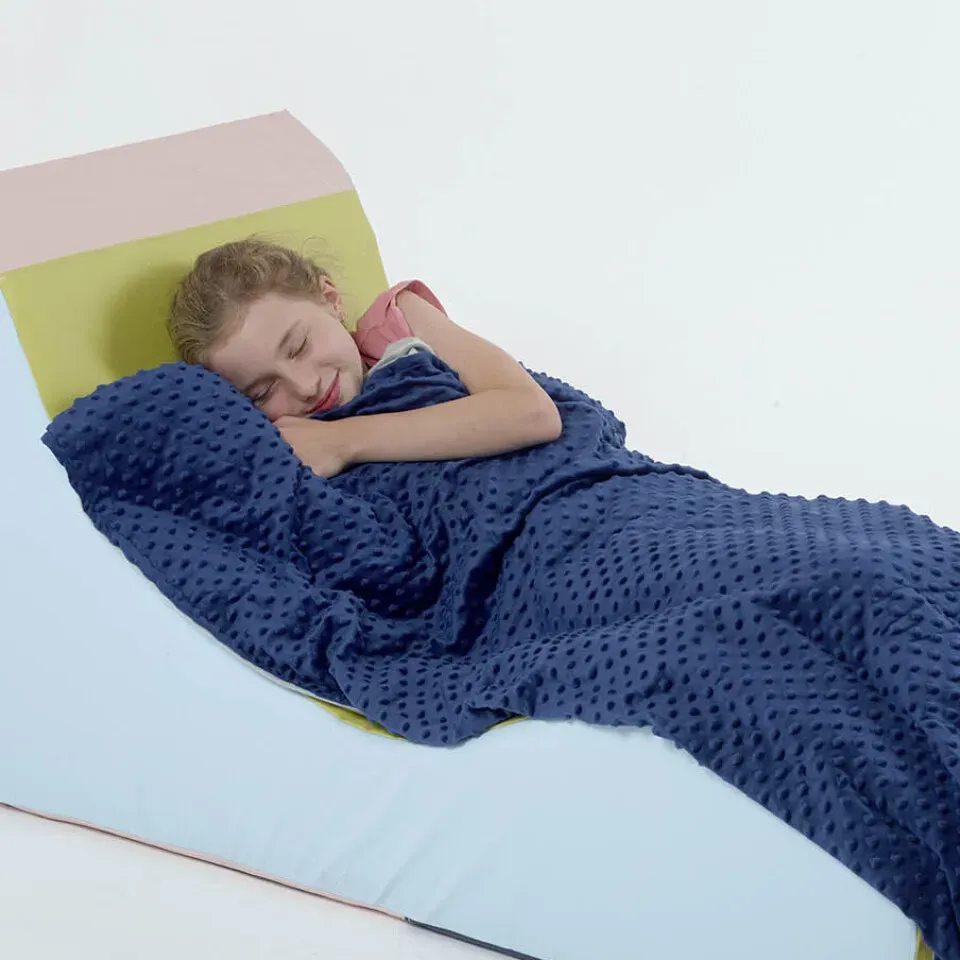
I am the sensory lead in a Mental Health Trust in the Midlands and have responsibility for introducing ‘sensory modulation’ as a means to help all patients on our acute adult mental health wards to regulate and so engage more in therapeutic interventions. Ensuring there was enough appropriate weighted blankets formed part of this work.
According to the research, weighted blankets are an effective way to provide deep pressure touch for those who are over-stimulated or anxious, which is almost everybody in acute mental health inpatient services. This includes people who have autism or ADHD, but not at all exclusively, as shown in the RCOT weighted blanket guidelines, 2023. There is also evidence for the improvement of sleep and engagement and this last was why I as sensory lead was particularly interested, as if people are more settled and can engage more in therapy, they can hopefully recover quicker and so be home sooner. This is the plan! This means that many people in hospital have the potential to find a weighted blanket helpful, but especially those who are anxious, on edge, and finding it difficult to settle and so focus or engage with doctors, nurses, OTs, family and in the activities they could do to aid recovery.
Considerations
When wanting to use weighted blankets, some things need to be considered more when in an inpatient environment than at home, particularly around safety – like do they have a fire certificate and can they be washed between patients and is there a range of weights and how will they be stored as they’re quite bulky. In therapeutic settings, how blankets are assessed is necessary to consider, as it is no use buying a lot of blankets if they are not used well, or not used at all and just sit on the shelf in a cupboard.
This meant I had to consider:
1. Having a range of weights of blankets to match the weights of the in-patient population.
2. Finding blankets that met the safety standards of the organisation.
3. Training the OTs in how to assess and the whole teams in how to use the blankets to best enable regulation.
4. Practicalities of storage including accessibility and labelling.
Weights
To work out what was needed I took the different weights of all patients on one male ward and one female ward. Blankets need to be 10% of body weight or less, so I grouped patients’ weights into above and below 10 x the different weights of blankets available to see what each ward might need.
This meant that if 5 patients weigh 50kg or less, and 10 patients weigh between 50kg and 90 kg and 3 patients weigh more than 90kg, what was needed was one x 5kg blanket, 2 x 8kg and 1 x 9kg blanket.
The range was slightly different between male and female wards, which I took into account, needing more heavier blankets for the men’s wards. I then multiplied this by the number of wards – in our case 10. I thought most wards needed 4 blankets and 2 smaller wards needed 3. There were a few old ones, so I needed 32 in total, did the maths, and ordered accordingly!
Safety
It was important to have written information outlining the fire safety of the blankets, and our policy is that this is kept with the blankets in the boxes. I ideally needed the CE mark on blankets, or the equivalent. This meant that it couldn’t be bought from any distributer but need a reputable company who have done the research and can evidence that. Reputable companies often cost a lot more and this can be a difficulty – shopping around meant I got the quality I needed for half the price, so is to be recommended!
There were safety considerations around infection control as well, with washing of blankets needing to be done in between patients. Removable covers help with this enormously, although peers tend to assign a blanket to an individual for each admission, then only wash when they are discharged.
Blankets are heavy and can break washing machines, then take a long time to drip dry as tumble dryers can melt beads, so whilst blankets can be machine washed if needed, to not need to wash the whole blanket every time but only the cover is a great advantage.
Training
Training is important as there are guidelines that need to be followed and recorded, but also inspiration to be given. I believe that blankets are a great tool for regulation for many people, and whilst safety guidelines are vital, they can also be time consuming to document and can put OTs off prescribing them. Inspiration as to the benefits can help the blankets get out the box in a storeroom, which is safer but not at all helpful to patients. Risks can be significant and need to be considered but then mitigations put in place – mitigate and use rather than avoid is what I’ve come to believe. Therefore, consider the right weight, but also things like: how able the individual is to move their arms so can they take off the blanket if they don’t like it; do they have physical health conditions that mean a lower heart rate can be risky and so they need less time or a lower weight; is the individual able to understand that it can only be used for 20 minutes, when it needs to be taken off due to the lowering of the heart rate? 20 minutes should do the job and help someone relax and settle and this is how they should be sold. Plus, how you remove and replace with a normal blanket needs thinking through for some people, but shouldn’t be prohibitive, as in don’t not use a blanket because of the upset, as the benefits outweigh the careful removal.
Much of the assessment is trial and error – do they like it, how do they feel, do they understand the reasoning, or can they show us whether they like it or not if the blanket is prescribed in discussion with the team in their best interest. Most training is helping the OTs (and it needs to be an OT in hospital settings) to understand the risks and benefits and to encourage them to dare to prescribe, plus how to fill in the paperwork, which can be arduous but worth it. Then to get the wider team to use them as needed, so accessible 24/7 and understanding the restrictions, but equally importantly the benefits – which can be great.
Practicalities
Storage is something to consider, as the blankets take up room. I use plastic boxes, which can be labelled with the patient’s name and a summary of the risk guidance – 20 minutes, keep arms free, don’t cover the face, observe vital signs… Then where to keep that box so the nurses know where it is 24/7, but it isn’t in the way. It might not be advisable to keep them in patent’s rooms, due to the 20-minute rule, but I don’t want them stuck where no one will think to get them out. Under the desk in the nursing office is where they can live when assigned to an individual, but others use the sensory room or storeroom or laundry… as long as the whole team knows and believes in the benefits, then they will be used.
One other thing to consider practically, is if the patients like them and find them cuddly and so want to spend time underneath one. Some blankets have rough covers and some soft. People usually like the soft and find them comforting. They come as a complete unit, and it isn’t just the weight that is therapeutic from a sensory point of view. Think comfort and soft and friendly – even cat or dog-like, not only heavy, and again, they will be used more often, which is the point.
In conclusion
Having a total of 38 weighted blankets has been a great investment across our 10 acute wards. Some are used more than others, the reasons for which boil down to a combination of the accessibility of the tools – where the blankets are kept – and the training in how to use them, the know-how. However, underpinning both of those, and in my view more significantly, is the inspiration – the belief that they can be really effective in lessening distress and enabling regulation, based on the evidence and experience. Having seen the impact with some of our people, I am a believer, and I share my belief with peers, aiming to inspire as I go. Blankets are a key part of the kit that can help patients to settle, to be less scared and so to engage and recover quicker. Which has to be a positive benefit that I will continue to promote for years to come!
References:
RCOT launches official weighted blankets guide | RCOT
Dr Janet Allison
Sensory lead, Derbyshire Healthcare NHS Foundation Trust
Keep reading
The experience of practitioners who have worked with autistic children in Sensory Rooms. Part 6
TFH are advocates of the Sensory Room and the first five parts to this extended blog testify to their usefulness. But very little in this world, save love and perhaps the bicycle, is an unall
The experience of practitioners who have worked with autistic children in Sensory Rooms. Part 5
practitioners described the SR Room as an effective teaching and learning environment and some considered this its main purpose.
The experience of practitioners who have worked with autistic children in Sensory Rooms. Part 4
This is the fourth instalment of our discussion of the work of by Dr. Katy Unwin, Dr. Georgina Powell and Dr. Catherine...