What is a weighted blanket?
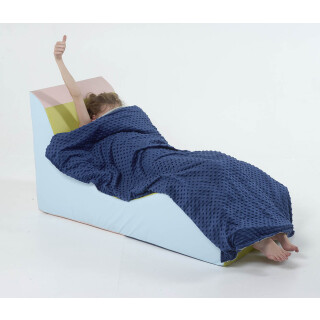
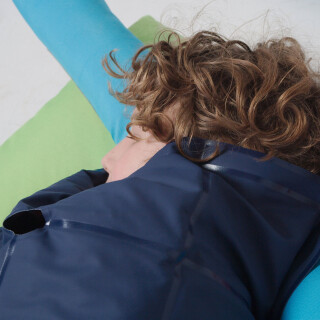
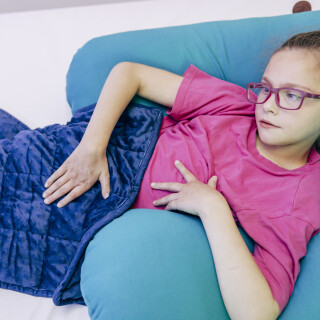
A weighted blanket is a blanket with weight sewn evenly through it, so it presses down gently across the whole body rather than in one place. Ours are filled with silicone beads, which are dense, so the blankets are thinner for their weight than many others.
Which weighted blanket should I choose?
Weighted Blanket with Minky Dot cover. Our standard Weighted Blanket comes in 8lb, 12lb, 18lb and 20lb weights. The 20lb Weighted Blanket is the largest at 180 x 130cm. Each comes with a soft polyester Minky Dot cover that comes off, with raised dots on one side and a smooth plain side on the other.
Weighted Quilt for clinical and care settings. The 11lb Weighted Quilt has no seams at all, so there's nothing to pick at and nowhere for germs to collect. It's 142 x 84cm, can be cleaned with 1,000ppm chlorine where infection control matters, and is just as easy to wash at home, where it dries quickly.
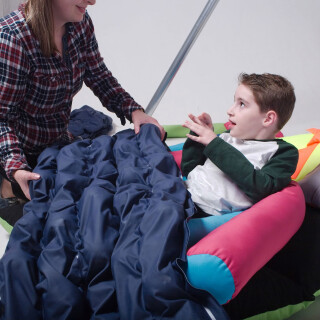
Calming Ball Blanket. The Calming Ball Blanket is lighter, at 1.5kg and 142 x 82cm. It's also seamless and made from hospital-grade bedding material, so it's easy to clean thoroughly.
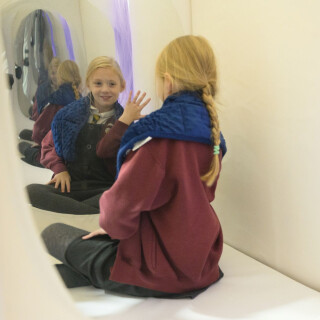
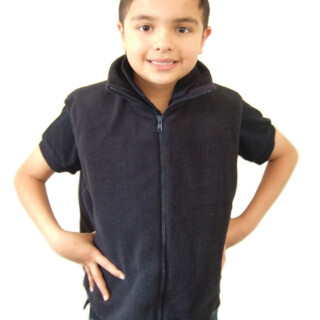
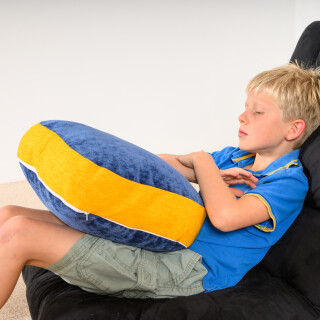
Smaller weighted pieces. When a whole blanket is too much, try something smaller. The Weighted Pad is 50 x 50cm and 2kg, for a lap or shoulders. There's also the Weighted Pillow, Weighted Scarf and Weighty Snakey. Weighted Vests come in seven sizes.
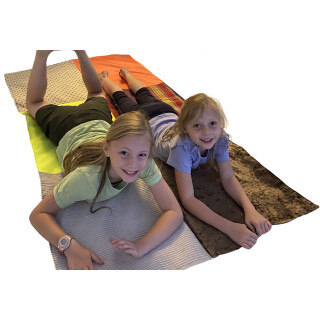
Without the weight. The Crunchy Tactile Blanket is about texture rather than weight. For firm pressure from the sides instead of from above, see the Squeeze Machine and the rest of our Deep Pressure range.
How heavy should a weighted blanket be?
Most suppliers, including us, use about 10% of the user's body weight as a guide. Treat that as a ceiling, not a target: if you're between two weights, choose the lighter one. Above all, the person must be able to move the blanket off by themselves. For a child, or for anyone who can't easily tell you it's too heavy, ask an occupational therapist to help you choose.
Reactions vary
Most descriptions of weighted blankets use one word: calming. For many people that's true. But a weighted blanket is a strong sensation, and for someone who has never had a dependable sense of where their body is, it can arrive all at once and feel exciting or unsettling rather than soothing. Peter Tidmarsh, our Managing Director, has written about the time he saw that happen, in Weighted blankets: reactions vary. So introduce one gently: start with a short session while you're with them, watch how they respond, and take it off straight away if they're unhappy.
Using a weighted blanket safely
Never use a weighted blanket to hold someone still, and never let it cover their face. Stay with anyone who can't take it off themselves. Take extra care before using one overnight: NHS and Royal College of Occupational Therapists guidance is cautious about weighted blankets during sleep, especially for children. The RCOT weighted blankets guide is written for occupational therapists but is useful reading for parents and carers too.
Weighted blankets for schools and care settings
Where a blanket is shared between several people, cleaning is the deciding factor. That's why we make the seamless Weighted Quilt and Calming Ball Blanket, which can be cleaned thoroughly between users. Schools and settings can pay by purchase order, and VAT relief is available on several products here, including the Weighted Quilt, the 20lb Weighted Blanket and the Calming Ball Blanket, for eligible buyers. A weighted blanket also works well in a calming room.
Proprioception and deep pressure, in plain words
Proprioception is the sense that tells you where your body is and what it's doing, without looking. It comes from the muscles, joints and tendons and runs in the background, so most of us never notice it. The occupational therapist A. Jean Ayres described it in the 1960s and 70s as part of her work on sensory integration. For some people it's unreliable, and moving takes more effort and feels clumsier as a result.
Deep pressure is firm, even pressure on the body: a hug, a heavy blanket, being wrapped up tight. The autistic author and scientist Temple Grandin did a great deal to bring it to wider attention. Weighted blankets give deep pressure through their weight. Compression gives it by squeezing from the sides, as a weighted vest or the Squeeze Machine does.
Heavy work means pushing, pulling, carrying and climbing: moving against resistance. Occupational therapists often suggest it, and much of physical play is exactly that.
Body awareness is proprioception at work: knowing where your hands are when you open a tricky packet, or how hard to push a door. Praxis, or motor planning, is working out how to do a movement you haven't done before, and it leans heavily on that same sense.
Ayres Sensory Integration® is a registered approach, and trained practitioners can be found through national occupational therapy associations.
Written by John Tidmarsh, TFH UK.