This is the second instalment of our discussion of the work of by Dr.Katy Unwin, Dr.Georgina Powell and Dr. Catherine Jones of the Wales Autism Research Centre, School of Psychology, Cardiff University.
The researchers conducted interviews with ten practitioners.They identified six themes reflecting beliefs about Sensory Room(SR) use with autistic children.
These were
- SRs benefit behaviour, attention and mood.
- SRs have distinct properties that facilitate benefits
- The use of the SR should be centred on the child’s needs
- They are most effective when the practitioner plays an active role
- They can be used for teaching and learning.
- However, they can present challenges.
- .
In our first instalment (see TFH Sensory Rooms Blogs) we summarised the research into theme 1. This part will discuss theme 2.
Sensory Rooms have distinct properties that facilitate benefits
Researchers believed that there were distinct properties that SRs have that are beneficial
The most important was that the child had control over their environment. This was felt to reduce challenging behaviours.
One practitioner explained that control over the SR enabled modulation of the environment so that it could be tolerated, “Getting them to control the room. If it’s too loud or it’s too quiet they can cope with it”.
Practitioners repeatedly stated that the motivational nature of the SR led to multiple beneficial outcomes including communication, “It’s a motivating session for them, so you tend to get better communication.” It was also suggested that preferred objects needed to be identified within the room to enable motivation and subsequently, communication, “I think one of the primary ways that I use it, is finding preferred and non-preferred objects. It’s just getting them motived and going right, they love that. Let’s get asking for that and you know using it as a form of communication”.
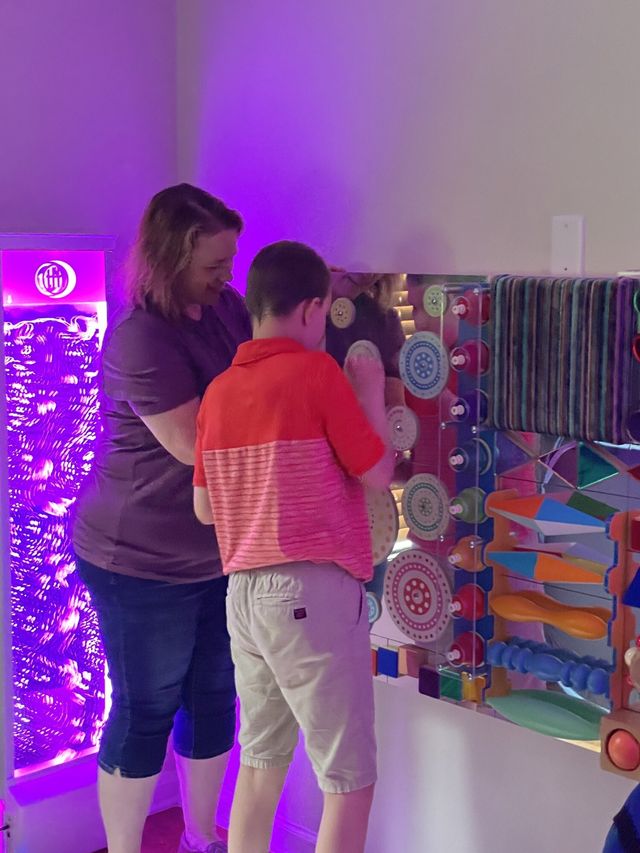
Practitioners described how being in the SR facilitated relationship building, and that the relationships built in the SR could bring about other benefits. They believed that the amount of interaction between the child with their practitioner and peers increased within the SR. It was suggested that because the children were enjoying the SR, they were more willing to accept other people sharing their space. Many practitioners stated that relationships could be built more quickly and were of better quality to those built within the classroom, linking closely with the theme of the ‘Active practitioner’. It was also reported that the relationships built in the SR could be transferred to the classroom.
TFH’s less academic research. largely consisting of comments by teachers, supports the view expressed above, that it is the sharing of the room both with the practitioner and with other children, not necessarily those with autism, that benefits relationship building and that this is indeed an important benefit.
Citations:
Katy L. Unwin, Georgina Powell, Catherine R.G. Jones, A sequential mixed-methods approach to exploring the experiences of practitioners who have worked in multi-sensory environments with autistic children, Research in Developmental Disabilities, Volume 118, 2021, 104061, ISSN 0891-4222, https://doi.org/10.1016/j.ridd.2021.104061.
(https://www.sciencedirect.com/science/article/pii/S0891422221002109)
TFH, and indeed everyone working in the Sensory Room field, would welcome any comments arising from this article. If you have conducted or know of any research or observations on behaviour please let us know: John.t@tfhuk.com and we will post it