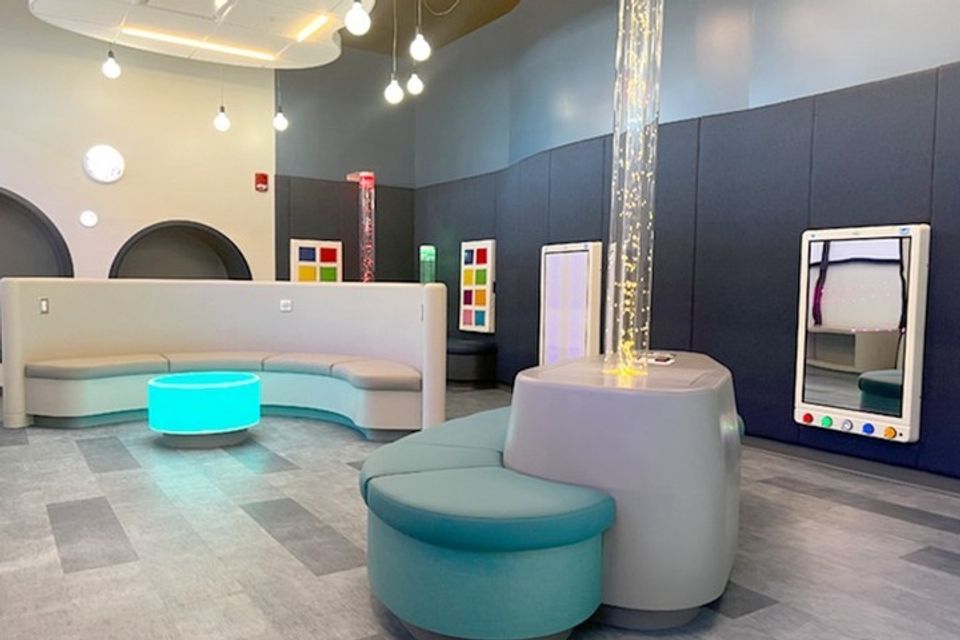
Before we consider the merits of using a sensory room for a child who exhibits ADHD symptoms, we need to ask ourselves what we are hoping to achieve.
Because there is a danger that the outcome could be the absolute opposite of what we would like.
ADHD children often experience sensory overload. They are easily distressed by environments where there is noise, frequent movement, and strong, especially flashing, lights. A typical environment would be a supermarket or a fast-food restaurant. Even the bustle of the classroom can be distressing. This manifests itself in frustration and often anger (1).
In everyday life, these distressing distractions are beyond her control. (2)
Research has shown that a lack of self-confidence is a marker for ADHD. It has further been suggested that a lack of confidence can lead to a young person self-diagnosing themselves as suffering from ADHD (3).
It is easy to imagine that a sensory room is an extreme example of the sort of environment that will exacerbate the anxiety a child with ADHD experiences.
But the beauty of the sensory room is that it is so flexible.
If we use the equipment intelligently, we can achieve an extremely calming environment, one that in no way challenges our ADHD child(4).
Gentle music, the chromatheme projections, the rhythm of the bubble column and the tacticity of a weighted scarf are all available.
Once we have won her confidence, that here is a place where she feels comfortable and happy, we can allow her to control her environment more. We may suggest she change the colors on the bubble column or vary the speed of the bubbles. We may introduce some classical music, perhaps Beethoven’s Moonlight Sonata, Mozart’s Piano Concerto No 21, or Erik Satie’s Gymnopédie No. 1.
The approach should be gradual, slowly building her confidence and self-esteem.
It is likely she will enjoy her time in the room. When someone enjoys what they are doing, it is so much easier to encourage a more positive attitude.
(1) Gonzales, Grossman y Santos, Universidade da Sagrada Família. SP. Transtorno do déficit de atenção com hiperatividade
(2). Polanczyk G, Lima MS, Horta BL, Biederman J, Rohde LA. The worldwide prevalence of ADHD: a systematic review and metaregression analysis. Am J Psychiatry. 2007;164(6):942–948. doi: 10.1176/appi.ajp.164.6.942. [DOI] [PubMed] [Google Scholar
(3). the University of East Anglia (UEA) in Norwich and mental health Norfolk and Suffolk NHS Foundation Trust
(4). Mangeot SD, Miller LJ, McIntosh DN, McGrath-Clarke J, Hagerman RJ, Goldson E. Sensory modulation dysfunction in children with attention deficit hyperactivity disorder. Dev Med Child Neurol. 2001;43(6):399–406. doi: 10.1017/S0012162201000743. [DOI] [PubMed] [Google Scholar
Keep reading

Designing a Sensory Space Around Students with Visual Impairments
How TFH partnered with Western Pennsylvania School for Blind Children to create a sensory environment built around the individual needs of its students.
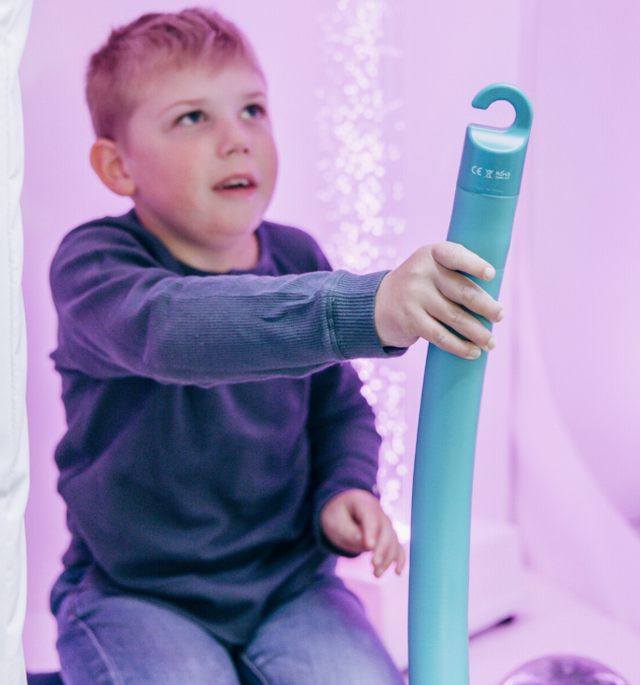
All shook up, vibration in the sensory room
Many years ago, I visited the DeHartenburg Institute in the Netherlands, the birthplace of Snoezelen, the original senso...

Projectors in the Sensory Room – a new development
Ever since the birth of the sensory room, the projector has been at the heart of the installation. In many ways, it sets...