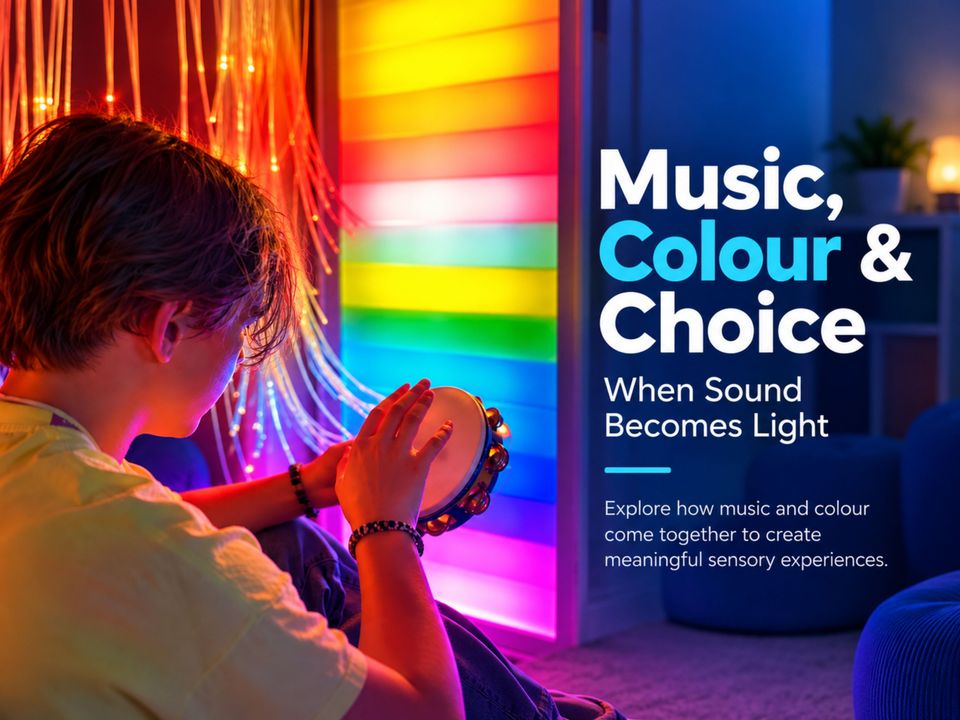
Music can fill a room. Colour can completely change how that room feels. But something particularly interesting happens when sound and colour begin working together.
This relationship has long been explored within Snoezelen-MSE. Maurits Eijgendaal, senior consultant and President of the International Snoezelen-MSE Association (ISNA-MSE), has specifically taught on the use of colour and sound in multisensory environments. In ISNA-MSE training, Eijgendaal describes colour as something that can influence perception and experience, while sound surrounds us even when we are not consciously attending to it.
For TFH, there is another piece we love: choice.
What Colour Does Your Music Feel Like?
There isn't one correct colour for a sound.
A favourite song might feel blue to one person and bright yellow to someone else. A low note might invite red. A clap might become a flash of light. A voice might send colour travelling across a room.
That individual response matters.
Eijgendaal's work encourages us to think about discovering an individual's own “rainbow” rather than simply deciding which colours should be presented to them.
It fits beautifully with the wider MSE philosophy: sensory experiences are not simply delivered to someone. They are explored with them, with relationship and individual preference at the centre.
When Sound Becomes Something You Can See
This is where interactive sensory equipment gets really interesting.
With a TFH Sound to Light Panel, sound becomes visible. Different qualities of sound trigger different illuminated responses. Speak, sing, clap, play music or experiment with your voice and watch the panel respond.
Our Ladder Lights Panel offers another way to explore the connection. Make a sound and illuminated rungs respond, then gradually disappear. Change the volume and watch what happens.
Suddenly, sound isn't only something you hear.
You can see it happen.
That creates a wonderfully simple cause-and-effect experience:
I make a sound → something changes → I can try it again.
No right answer. No required performance. Just an invitation to explore.
Give Them the Controls
Colour can also become a choice rather than something selected by the person designing the sensory room.
TFH interactive controls and the MSE Genie App allow users to select, mix and hold colours and adjust brightness across compatible sensory equipment.
A bubble tube doesn't always have to be blue because someone else decided blue is “calming.”
What colour would you choose today?
That question is much more TFH.
Build a Sensory Space That Listens
The strongest multisensory environments aren't necessarily the rooms with the most equipment.
They're spaces with opportunities to notice, choose, experiment and respond.
Music can become colour.
Sound can become light.
A voice can change the room.
And the person exploring it gets to discover:
“I did that.”
That is where sensory equipment becomes more than something beautiful to watch. It becomes an opportunity for choice, control, cause and effect, connection and play.
Play is Powerful.
Together for Every Ability.
TFH Canada draws on internationally established Snoezelen-MSE principles in its approach to multisensory environments. Maurits Eijgendaal introduced Snoezelen-MSE in Scandinavia in the 1980s and has been an international teacher and leader in the field