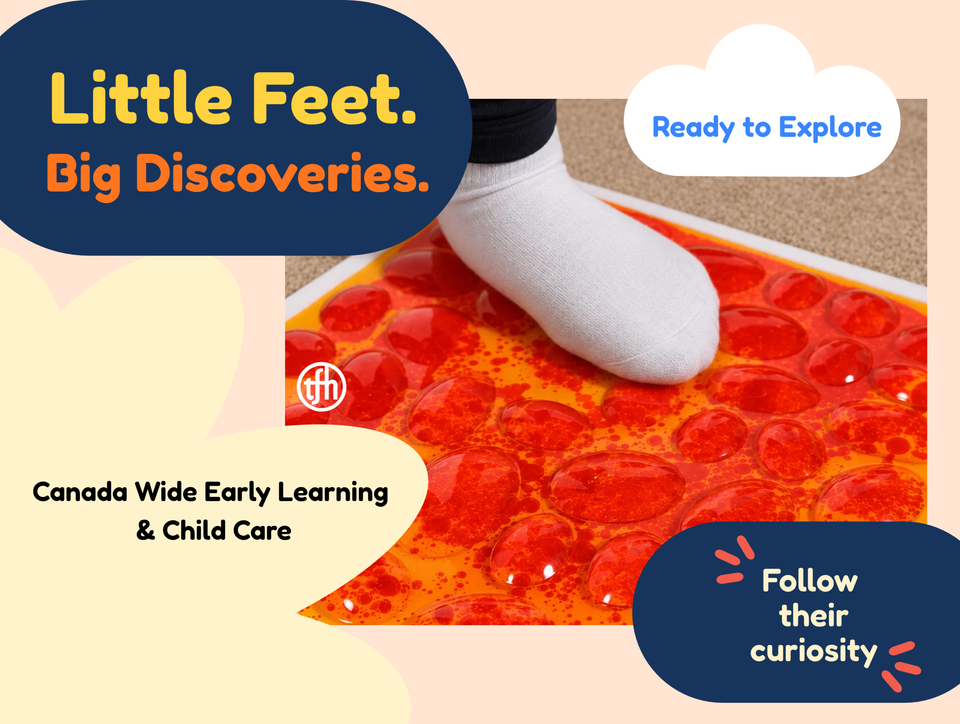
What if we built it taller? What if we turned it upside down? What if we tried something completely different?
Two little words — What if? — can open up a whole world of discovery.
For children in kindergarten, approximately 4 to 6 years old, curiosity is one of the most powerful learning tools they have. Every time they stack, sort, connect, balance, pull apart or rebuild something, they're exploring how the world works.
And the best part? They don't need instructions to get started.
Welcome to the wonderful world of loose parts play, where little hands make big discoveries and STEM learning happens naturally through exploration.
Ready to Explore: What Are Loose Parts?
Loose parts are open-ended, movable materials that children can carry, combine, rearrange, redesign and explore in countless ways.
Unlike toys with a specific purpose or predetermined outcome, loose parts invite children to decide what happens next.
A colourful collection of shapes might become a tower, a repeating pattern, a bridge or an imaginary city. Wooden blocks might become a roadway one day and a balancing experiment the next.
The possibilities change every time a child asks, "What if?"
In kindergarten and early learning environments, loose parts provide meaningful opportunities to explore Science, Technology, Engineering and Mathematics (STEM) through hands-on play.
Children aren't simply building something. They're experimenting with cause and effect, developing spatial awareness, testing ideas, recognizing patterns and discovering solutions.
They're learning to think like scientists, designers, mathematicians and engineers — without even realizing it.
Why Loose Parts Matter in Early Learning
Between approximately 4 and 6 years of age, children are developing foundational skills that support learning, independence and participation.
Open-ended play creates opportunities to strengthen:
- Cognitive development: Problem-solving, planning, predicting and flexible thinking.
- Early mathematics: Counting, sorting, sequencing, patterns, measurement and geometry.
- Scientific thinking: Observation, experimentation, cause and effect, and making predictions.
- Physical development: Fine motor coordination, hand strength, bilateral coordination and spatial awareness.
- Creativity: Imagination, innovation and discovering multiple solutions.
- Social development: Communication, collaboration, sharing ideas and negotiating different approaches.
Perhaps most importantly, loose parts allow children to explore at their own pace, following their interests and abilities.
There isn't always a correct answer, and there doesn't need to be.
Ready to Play: Five Ways to Bring STEM to Life
The magic of loose parts lies in the variety of materials and the opportunities they create.
Here are five material groups that bring purposeful STEM exploration into kindergarten classrooms, child care programs and early learning spaces.
1. Patterns, Sorting & Counting — Making Math Meaningful
Ready to sort, match and discover?
Colourful shapes, textured pieces, counters, stacking materials and geometric manipulatives invite children to explore early mathematical concepts through movement and play.
Children might organize materials by colour, size, shape or texture, create repeating patterns, compare quantities or discover different ways to group the same objects.
These simple experiences introduce classification, sequencing, counting, symmetry and early geometry.
Try asking:
- What else could we sort these by?
- Can you make a pattern that repeats?
- What happens if we add one more?
- How many different ways can you arrange these shapes?
The learning connection: Early numeracy, pattern recognition, classification, logical thinking and mathematical language.
2. Architectural Connectors — Little Engineers at Work
Ready to build something amazing?
Construction pieces, interlocking shapes, connectors and building materials introduce children to engineering concepts through trial and discovery.
A tower falls. A bridge bends. A structure leans.
What happens next?
Children investigate why something didn't work and begin experimenting with new approaches. They might widen the base, change the shape, add another support or redistribute the weight.
Every adjustment becomes an opportunity to explore gravity, balance, stability, structure and spatial relationships.
And when their creation tumbles?
That's not necessarily failure. That's information for the next experiment.
Try asking:
- What could make your tower stronger?
- How can we build a bridge between these two points?
- What happens if we change the base?
- Can you build something that balances?
The learning connection: Engineering design, physics, geometry, spatial reasoning, persistence and problem-solving.
3. Natural Textures — Discovering Science Through the Senses
Ready to touch, compare and wonder?
Nature offers an extraordinary collection of loose parts.
Smooth stones, pinecones, leaves, shells, wood pieces and other appropriately selected natural materials invite children to observe and investigate the physical world.
Some materials are rough. Others are smooth. Some are heavy, light, flexible, rigid, round or irregular.
Children begin noticing differences, identifying similarities and exploring how materials behave.
Natural loose parts also provide opportunities to introduce earth science, environmental awareness and sensory observation.
Try asking:
- What do you notice about these materials?
- Which feels heavier? Which feels lighter?
- What happens when we arrange them from smallest to largest?
- Can you find two things that feel different but look similar?
The learning connection: Scientific observation, comparison, classification, descriptive language and sensory exploration.
4. Tools & Manipulatives — Small Movements, Big Learning
Ready to twist, turn and tinker?
Tongs, scoops, chunky fasteners, gears, connecting pieces and other age-appropriate manipulatives invite children to investigate how objects move, connect and work together.
As children grasp, rotate, pinch, push, pull and manipulate materials, they're developing important fine motor skills.
These movements also create opportunities to explore basic mechanics, cause and effect, hand-eye coordination and the relationship between effort and movement.
Try asking:
- What happens when you turn this?
- Can you move that piece another way?
- Which tool works best for picking this up?
- What could you change to make it easier?
The learning connection: Fine motor development, coordination, mechanical exploration, motor planning and problem-solving.
5. Open-Ended Construction — Imagination Meets Innovation
Ready to create something entirely your own?
Give children an assortment of shapes, connectors, building pieces and movable materials, then step back and see what happens.
One child might build a house. Another might create a vehicle, an animal habitat or something that doesn't have a name yet.
The learning happens in the decisions they make along the way.
Which pieces fit together? How can the design change? What happens when they take something apart and start again?
Open-ended construction encourages creativity while strengthening planning, sequencing, spatial reasoning and flexible thinking.
Try asking:
- Tell me about what you're creating.
- What would happen if you changed this part?
- Can you think of another way to build it?
- What will you try next?
The learning connection: Creative thinking, engineering, communication, experimentation and innovation.
Ready to Connect: Ask Better Questions, Inspire Bigger Discoveries
Sometimes the most valuable teaching tool in the classroom isn't another product.
It's a question.
When children are deeply engaged in play, adults can support learning by observing, listening and encouraging exploration without taking over.
Instead of immediately demonstrating the correct way to build something, try inviting the child to investigate.
Replace "Let me show you how" with "What do you think would happen if…?"
That small change gives children ownership of their discoveries.
It also creates opportunities for educators to observe how children approach challenges, communicate ideas, solve problems and adapt their thinking.
A Simple STEM Invitation to Play
You don't need an elaborate lesson plan or a dedicated STEM room to begin.
Start with a small collection of safe, age-appropriate loose parts:
- A variety of colourful geometric shapes
- Building pieces or architectural connectors
- Materials with different sizes, weights or textures
- Simple tools for sorting, transferring or manipulating
Place the materials where children can see and reach them. Allow time for exploration, and resist the urge to define what the finished creation should look like.
Then introduce one question:
"What could we make with these?"
Watch what happens.
Safety matters: Select materials appropriate for children's ages, abilities and supervision needs. Inspect loose parts regularly, avoid choking hazards, and follow your program's safety and hygiene policies.
Every Ability. Endless Possibilities.
One of the greatest strengths of loose parts play is its flexibility.
Materials can be presented at different heights, in smaller collections, with larger easy-grip pieces or with additional visual and physical supports.
Children can participate by touching, choosing, sorting, connecting, observing, directing a partner or creating independently.
There is no single way to explore, and every child can contribute something meaningful.
At TFH Canada, we believe the most engaging learning environments are those that invite participation, encourage curiosity and give children the freedom to discover what works for them.
Whether you're creating a kindergarten STEM centre, refreshing an early learning classroom or introducing hands-on materials into a sensory play space, thoughtfully chosen loose parts can help turn everyday moments into opportunities for discovery.
Because STEM doesn't start with instructions. It starts with curiosity.
And sometimes, the biggest discoveries begin with two little words:
What if?
Ready to Bring More Discovery Into Your Classroom?
Explore TFH Canada's collection of sensory play materials, construction toys, manipulatives and hands-on learning tools designed to encourage curiosity, creativity and participation.
Need help choosing materials for your kindergarten classroom, child care program or early learning environment?
We're here to help you find the right tools for your little explorers.
[Explore Early Learning & STEM Products]
TFH Canada — Therapy • Freedom • Happiness
Together for Every Ability.
Keep reading

Music, Colour & Choice: When Sound Becomes Light
What happens when sound becomes something you can see? Explore the connection between music, colour and choice in multisensory spaces, inspired by the work of Maurits Eijgendaal and brought t
Your Teen Grew Up. Did Their Sensory Space Grow With Them?
sensory room for teenagers, sensory space for teens, sensory equipment for teenagers, calming space for autistic teenager, teen sensory room Canada.
Sensory Room Ideas Canada: Creating Sensory Spaces With Choice
Looking for sensory room ideas in Canada? Discover how thoughtful sensory spaces can create more opportunities for choice, movement, interaction and quiet. Start with the person, follow what